
A Smarter Path for the Future of Nuclear Energy
Fast reactors represent a next-generation approach to nuclear power—designed to deliver more energy, reduce waste, and improve long-term sustainability compared to today’s conventional reactors.
By using high-energy neutrons, fast reactors are able to extract far more value from nuclear fuel. Even more compelling, they can operate using recycled fuel from existing reactors, turning what was once considered waste into a valuable energy resource.
This combination of efficiency, waste reduction, and performance positions fast reactors as a powerful solution for meeting rising global demand for affordable, reliable, and secure energy.
Fast reactor technology isn’t theoretical. Since the 1950s, approximately 20 fast reactors have been built worldwide, including multiple systems in the United States that successfully demonstrated testing, operational safety, and even commercial power production.
Today, new designs are being developed to modernize and scale this proven technology for the energy challenges ahead.
What Make Fast Reactors
DIFFERENT
All nuclear reactors produce energy through nuclear fission—the process of splitting atoms to release heat. Most reactors operating today rely on water to cool the system and slow down neutrons so the reaction can continue.
Fast reactors take a different approach.
Instead of slowing neutrons down, they keep them moving fast. This is achieved by using liquid metal coolants—such as sodium or lead—which efficiently remove heat without interfering with the neutron reaction.
This fast-neutron environment unlocks unique advantages in fuel efficiency, waste reduction, and overall system performance that traditional reactors simply cannot match.
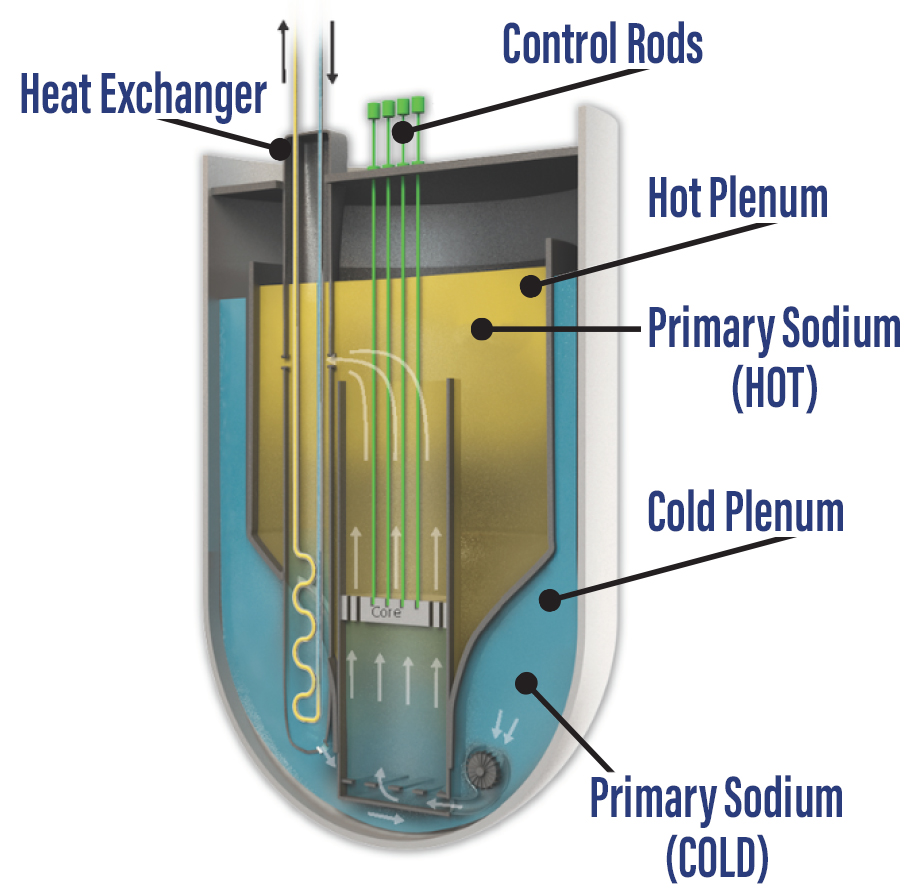
SOURCE: U.S. DOE Office of Nuclear Energy (2024); Idaho National Laboratory
How Fast Reactors Generate
POWER
Fast reactors can use a variety of fuel types, including metallic, ceramic, or molten salt fuels.
Liquid metals are most commonly used as coolants, though some designs also explore gas or molten salt cooling—so long as the system avoids materials that slow neutrons.
Pumps circulate the coolant through the reactor core, carrying heat away from the fuel. That heat is then transferred to water, creating steam.
The steam spins a turbine to generate electricity, after which it is condensed and reused. Meanwhile, the primary coolant is continuously recycled back into the core, allowing the process to repeat efficiently and reliably.
Demonstration of Fast Reactors from the US Department of Energy
SOURCES: U.S. DOE Office of Nuclear Energy: https://www.energy.gov/ne/articles/nuclear-101-what-fast-reactor
WHY FAST REACTORS
MATTER
Fast reactors offer several major advantages that make them attractive from both an investment and public-impact perspective.
EXCEPTIONAL
FUEL EFFICIENCY
Fast reactors can extract up to 100 times more energy from the same nuclear fuel used in today’s water-cooled reactors.
They accomplish this by converting unused uranium—most of which remains untouched in conventional reactors—into plutonium that can also produce energy.
When fuel is continuously recycled, fast reactors dramatically reduce the amount of uranium required to generate the same level of power, improving long-term fuel security and cost efficiency.
DRAMATICALLY REDUCED
NUCLEAR WASTE
Fast reactors have the potential to cut long-term nuclear waste by up to 90%.
High-energy neutrons are far more effective at breaking down long-lived radioactive materials that would otherwise remain hazardous for hundreds of thousands of years.
Instead, these materials can be transformed into shorter-lived byproducts that decay to natural levels within a few hundred years—making waste storage simpler, safer, and more manageable.

BUILT-IN SAFETY
ADVANTAGES
Many fast reactor designs use liquid metal coolants with extremely high boiling points, allowing them to operate at low pressure. This significantly reduces the risk of high-pressure system failures.
Additionally, several designs use metallic fuel that naturally expands as temperatures rise. This expansion automatically slows the nuclear reaction, providing a passive safety response that does not rely on human intervention or external power.

HIGHER PERFORMANCE
AND FLEXIBILITY
Fast reactors operate at higher temperatures than traditional reactors, which improves efficiency and allows more energy to be converted into electricity.
These higher temperatures also make fast reactors well-suited for industrial applications, such as supplying heat for manufacturing or hydrogen production.
Because of their compact, high-power design, fast reactors can generate up to three times more power than similarly sized water-cooled reactors—making them ideal for scalable, high-output energy solutions.

A Proven U.S. Track Record
Fast reactor development in the United States dates back to the early days of nuclear energy, with multiple successful programs demonstrating feasibility, safety, and performance.
Key milestones include the world’s first nuclear electricity generation, advanced safety demonstrations, fuel recycling research, and commercial-scale operation.
Today, fast reactor innovation continues through federal programs working alongside universities and private industry, helping bring modern, market-ready designs closer to deployment.
Bottom Line:
Fast reactors combine proven science with next-generation efficiency. They offer:
• More energy from existing fuel
• Less long-term nuclear waste
• Enhanced safety through passive design
• Higher performance in a smaller footprint
As energy demand accelerates and clean, reliable power becomes more critical than ever, fast reactors stand out as a scalable, forward-looking solution with strong long-term potential.